rift is an interactive video installation that frees the viewer to move physically through the recorded time of video. visitors engage the projected image alternately as explorers, navigating recorded time with their movements, and as painters, using their gestures as strokes on the video canvas. Timelapse video footage is fed through custom software that translates motion through the space of the installation into motion through the timeline of the video.
rift was conceived and developed by doron altaratz, scott fitzgerald, and eric socolofsky. It was initially installed at T-Minus 2005, a timelapse video show held at Synchronicity Space, New York City, February 2005. It was also been installed in the lobby of the Tisch School of the Arts and the great wall of Oakland (2009).
temporal navigation
video is an excellent medium for recording change over time. viewers are typically limited to experiencing these changes in a two-dimensional and linear fashion, displayed on a flat screen at a constant speed. rift is an interactive video installation that frees the viewer to move physically through the recorded time of video.
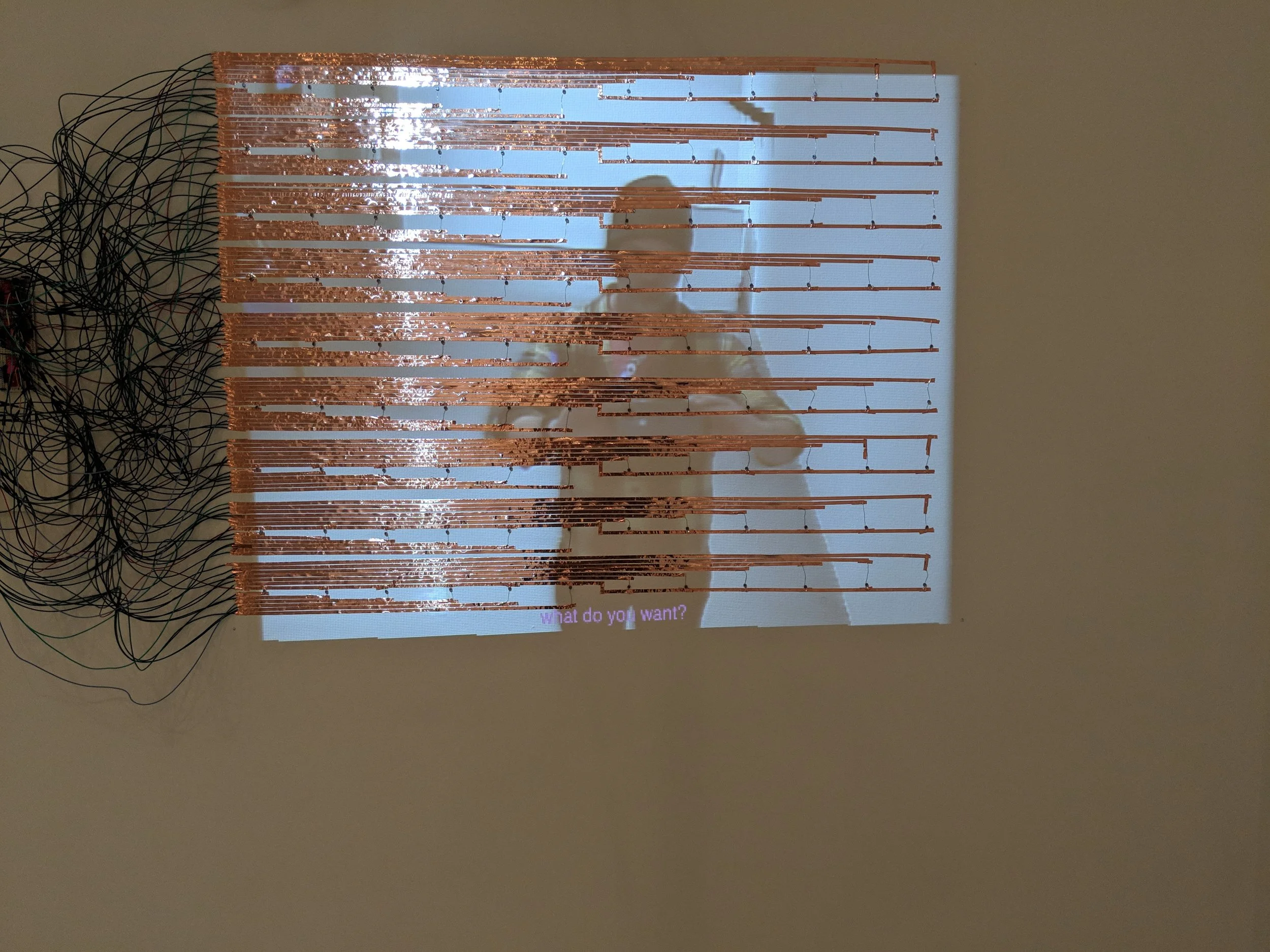
an image of a place at one moment in time is projected on a wall in the installation. a camera is trained on the space in front of the projection, through which visitors move. silhouettes appear gradually as visitors move in front of the camera. the longer one remains in an area, the further that area of the image progresses through time. participants often take an exploratory role in the piece, sampling moments in time from the recorded space. however, some become painterly, allowing their gestures to describe arcs of color and motion across the projected image.
spatial experience is always defined by the moment of inhabitation. one physical location may seem vastly different from one point in time to the next. in the space defined by rift, visitors gain access to the wealth of places previously isolated at given moments in time.
construction
rift began as a series of timelapse videos, each one day long, recorded in new york city, brooklyn, and elsewhere. this footage was reduced to a sequence of frames, which are fed into a custom software engine, built with cycling74′s max/jitter.
an infrared camera picks up visitors’ motion through the space of the installation, which is then fed into the software engine. areas of the projected image that correspond to the areas of motion in the camera’s field of view are manipulated depending on the amount of change; the longer an area of the installation registers change, the further forward in the timeline of the video that area of the projection moves. when that area of the installation is vacated, the corresponding area of the projection cycles back toward the beginning of the video’s timeline.
the engine also allows for interchangability of the timelapse footage. in its initial installation, the timelapse video footage was switched automatically every night. over the course of the installation, rift ran through 13 different locations, allowing visitors to explore the time-space of multiple locations over successive visits.